Showing posts with label george julian harney. Show all posts

Wednesday, 16 August 2023

George Julian Harney's unfinished column

George Julian Harney spent his final years in Richmond upon Thames, where he lived in a single room surrounded by mementoes and memories that stretched back more than half a century to the high tide of Chartism and his role as one of its most incendiary leaders.

After he died, in December 1897, he was buried, without a great deal of ceremony, in Richmond Cemetery, where his grave is marked by a monumental column erected by his second wife, Marie. Earlier this week, as I live within easy reach I paid Harney a visit.

Friday, 10 March 2023

Chartist thinking on slavery and abolition

I want to draw attention, a bit belatedly, to Tom Scriven’s excellent article on ‘Slavery and Abolition in Chartist Thought and Culture, 1838–1850’ for The Historical Journal.

This is the first comprehensive account of Chartist attitudes towards slavery and abolition, and certainly many early Chartists do not come out of it at all well. Influenced by the thinking of US president Andrew Jackson’s supporters, some adopted the view that wage labour was more exploitative than chattel slavery’, while alongside this there was a racist reaction to West Indian emancipation more extreme than has previously been acknowledged.

By 1842, however, various changes within the Chartist movement helped bring to the fore more consistently anti-slavery and even anti-racist sentiment within Chartist culture, as did growing exposure to American abolitionism, especially that of William Lloyd Garrison and Frederick Douglass. For this, the editor of the Northern Star, George Julian Harney, and the black Chartist William Cuffay take a great deal of credit.

The development of the anti-slavery ‘Free Soil’ ideology by American labour radicals also profoundly influenced the late Chartist position on slavery by inserting abolition into Chartist aspirations for land reform. Consequently, a core component of late Chartism was its own anti-slavery ‘Free Soil’ ideology, which informed pro-Union working-class agitation during the later American Civil War.

The full text of Dr Scriven’s article is available on open access. Download it in PDF.

Wednesday, 22 December 2021

Minute book of the Democratic Committee for Poland’s Regeneration: an exciting Chartist discovery

Minute books are absolutely central to the collective memory of any organisation. They record who was there, what they discussed and agreed, often what financial assets they had, and what they decided to do to advance their cause. No less so the Chartist movement.
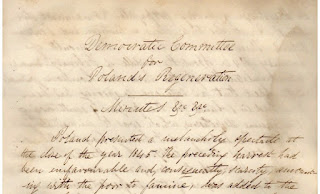
Extract from the minute book

Alas, of the many hundreds of minute books that must have at one time recorded the activities of local branches of the National Charter Association, its delegate bodies, its central executive and its satellite organisations, barely one has survived. So the news that the original hand-written minute book of the Democratic Committee for Poland’s Regeneration has come to light is hugely exciting.

The 62-page vellum-bound quarto notebook, hand-written by the prominent Chartist George Julian Harney, recorded the life of the committee between 1846 and May 1847. It includes a list of the 29 founder members, and of 70 later members, in alphabetical order by town of residence, followed by minutes of the committee’s meetings, and newspaper cuttings.

In addition to Harney, other leading Chartists involved in the committee included Feargus O’Connor, Ernest Jones, William Cuffay, Thomas Martin Wheeler and Philip McGrath. Among the European exiles taking part were the German radicals Karl Schapper and Heinrich Bauer, and BartÅ‚omiej Beniowski, a veteran of the 1831 Polish uprising and himself an active Chartist.

The story of the book’s discovery by the historian David Goodway (author of the classic London Chartism 1838-1848 [Cambridge University Press, 1982]) and of what it can tell us about the committee and its place in London radicalism is told in an article for Cairn International Edition by Fabrice Bensimon, Professor of Modern British History at the Sorbonne University. His article was translated by Adrian Morfee.

The full text of this fascinating article can be found (in English) here.

Friday, 1 June 2018

A list of Chartist leaders - but where did it come from, and when (and why) was it compiled?

My collection of Chartist ephemera now includes this intriguing four-page document. Entirely without preamble or explanation, it lists 44 of the best known figures in Chartism, their names apparently written in their own hand.

My first thought when I got my hands on it was that this was the delegate list for a conference taking place on 19 November 1841 - a date which appears very clearly on the final page.

However, with further investigation, that appears not to be the case, and I have to say that it is not entirely obvious when the list was created or why. What I do know, and some thoughts about what it might represent, are set out here.

Download a PDF showing the document in full.

Saturday, 20 May 2017

George Julian Harney on "something of vital importance"

In the summer of 1839, George Julian Harney found himself under arrest in Warwick Gaol and facing trial for his use of “seditious language” to foment the “Grand National Holiday” or general strike called for by the Chartist Convention.

Monday, 7 November 2016

Louis Blanc's Chartist connection: a letter to Holyoake

The French socialist Louis Blanc had been a significant figure in the provisional government of 1848. But despite having popular support for his plans to guarantee work for all, the left was a minority in government, and Blanc fled into exile after narrowly escaping arrest or worse.

Thursday, 3 July 2014

George Julian Harney: The Chartists were Right


George Julian Harney was among the most important of the Chartist leaders. Almost uniquely, he was active throughout the movement’s history, having been a radical long before the Charter was published and living on, his political interests undiminished, until near to the end of the 19th century.

Best known as a journalist and editor of the Northern Star, Harney was a staunch internationalist and a prominent figure in the National Charter Association’s post-1848 adoption of a socialist programme. It was Harney who befriended Engels, Marx and a host of European exiles in the wake of the year of revolutions, and Harney’s own paper, the Red Republican, which first published the Communist Manifesto in English translation.

Wednesday, 17 April 2013

What became of Helen Macfarlane? A Victorian mystery solved at last

Few knew her identity at the time, and fewer still remembered her in the years that followed, but Helen Macfarlane was probably the most influential woman in the Chartist movement.

Writing under the name Howard Morton, Macfarlane made the first English translation of the Communist Manifesto, which appeared in George Julian Harney’s Red Republican in 1850, and was described by Karl Marx as “the only collaborator on his spouting rag who had original ideas”.

Friday, 2 March 2012

George Julian Harney, 1817 - 1897

George Julian Harney was born in Deptford on 17 February 1817. Though still a young man when the Charter was first published, he was already immersed in the milieu of radical London politics, and would remain an important figure until long after Chartism had ceased to exist.
Though of much the same generation as Ernest Jones (born 1819), and often associated with him as the leading figures within Chartism after Feargus O’Connor disappeared from the scene, Harney could not have been more different.
The son of a sailor, Harney appeared destined for a life at sea, entering the Boys’ Naval School at Greenwich at age 11. Instead, however, he became shopboy to the Henry Hetherington, radical bookseller and publisher of the Poor Man’s Guardian.
Harney had been a member of the London Working Men’s Association, but after being influenced by more radical ideas, he became a founder of the East London Democratic Association.
At the first Chartist convention in 1839, Harney was behind moves to commit delegates to a general strike in the event that the petition to Parliament was rejected. Following his arrest, and fearing that the move lacked support, however, the Convention later withdrew the plan.
Harney escaped punishment when the jury refused to indict him. He moved to Scotland, married and returned to England where he became the National Charter Association’s organiser for Sheffield. Following the general strike of 1842, Harney was again arrested – and this time put on trial.
Harney subsequently joined the Northern Star, taking over as editor in 1845 and establishing the Fraternal Democrats in the same year. This organisation built important links with European socialists and radicals, and served as a left-wing faction within the Chartist movement.
After falling out with O’Connor, who owned the Star, Harney established first the Red Republican and subsequently the Friend of the People as avowedly socialist publications. Neither lasted long. After a further series of newspaper ventures, Harney moved to Newcastle to work for Joseph Cowen’s Northern Tribune.
In the post-Chartist period, Harney moved first to Jersey, and then in 1863 to the United States, where he lived for 14 years and worked as a clerk in the Massachusetts State House.
Returning to England, Harney wrote for the Newcastle Chronicle. He remained on the left throughout the rest of his life, writing jubilantly when well into his 70s of the Great Dock Strike that in many ways saw the birth of the modern trade union movement:
"Not since the high and palmy days of Chartism have I witnessed any movement corresponding in importance and interest to the great strike of 1889."
George Julian Harney died aged 80 on 9 December, 1897 and is buried in Richmond cemetery where his grave can still be seen.