Showing posts with label ernest jones. Show all posts

Thursday, 20 June 2024

In search of Tothill Fields Bridewell

Up in London today I thought I’d have a look at what remains of Tothill Fields Bridewell - the Westminster prison where the Chartist leader Ernest Jones was imprisoned in 1848 for sedition.

Here, just a five-minute walk from what is now Victoria Station, he and other Chartist prisoners refused to pick oakum and were put in solitary confinement on a diet of bread and water. Amid unsanitary conditions, and an outbreak of cholera in London, Jones was lucky not to share the fate of Joseph Williams and Alexander Sharp, two imprisoned Chartists who did not live to complete their sentences.

Friday, 18 August 2023

Three Chartist tankards: make mine a quart

 'Lot 473. A set of three graduated personalised pewter tankards engraved with the symbol of the Chartists'.

A larger version of this and other pictures can be found at the link below.

Over the years it has become more and more difficult to find Chartist memorabilia up for sale. So when I spotted these at auction I had to have them.

Slightly dented, and tarnished with age (and aren't we all), these three engraved pewter tankards are a solid link back to the days when men and women turned out in their thousands to hear big name speakers spread the message of Chartism at great monster meetings.

After all, what better way to thank the speaker than by presenting them publicly with a keepsake of their visit to your town which stressed the readiness of its radical population to fight for the Charter.

I have written about the tankards, what I think they are and what I think the inscription tells us on the Chartist Ancestors website. Go here to read it.

Wednesday, 22 December 2021

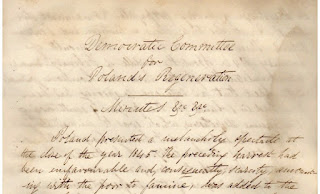
Minute book of the Democratic Committee for Poland’s Regeneration: an exciting Chartist discovery

Minute books are absolutely central to the collective memory of any organisation. They record who was there, what they discussed and agreed, often what financial assets they had, and what they decided to do to advance their cause. No less so the Chartist movement.

Extract from the minute book

Alas, of the many hundreds of minute books that must have at one time recorded the activities of local branches of the National Charter Association, its delegate bodies, its central executive and its satellite organisations, barely one has survived. So the news that the original hand-written minute book of the Democratic Committee for Poland’s Regeneration has come to light is hugely exciting.

The 62-page vellum-bound quarto notebook, hand-written by the prominent Chartist George Julian Harney, recorded the life of the committee between 1846 and May 1847. It includes a list of the 29 founder members, and of 70 later members, in alphabetical order by town of residence, followed by minutes of the committee’s meetings, and newspaper cuttings.

In addition to Harney, other leading Chartists involved in the committee included Feargus O’Connor, Ernest Jones, William Cuffay, Thomas Martin Wheeler and Philip McGrath. Among the European exiles taking part were the German radicals Karl Schapper and Heinrich Bauer, and BartÅ‚omiej Beniowski, a veteran of the 1831 Polish uprising and himself an active Chartist.

The story of the book’s discovery by the historian David Goodway (author of the classic London Chartism 1838-1848 [Cambridge University Press, 1982]) and of what it can tell us about the committee and its place in London radicalism is told in an article for Cairn International Edition by Fabrice Bensimon, Professor of Modern British History at the Sorbonne University. His article was translated by Adrian Morfee.

The full text of this fascinating article can be found (in English) here.

Friday, 2 March 2012

Chartism and the Labour Parliament of 1854

The Labour Parliament of 1854 was one of the last significant Chartist gatherings. A page on the Labour Parliament which also lists the 40 delegates who attended has now been added to Chartist Ancestors.
There is no clear date at which Chartism came to an end. For many, the disappointments and state backlash of 1848 were enough; others struggled on to 1858 when the National Charter Association held its final convention. A few still continued to describe themselves as Chartists for decades more.
But there is some sense in which 1854 marked the demise of the Chartist movement. It was both the year in which Chartism’s first historian, Robert Gammage, ended his account, and the year in which a Chartist Labour Parliament met and signally failed even to discuss Chartism’s political demands.
By the winter of 1853-54, the fight was clearly industrial and economic. Strikes and the first systematic use of lock-outs by employers were rife, and it would surely have been remiss of any socialist organisation (as the NCA had been since 1851) to ignore this battleground. Most notably, the Preston lock-out of 1853-54 was seen as crucially important. The photograph here shows George Cowell, a leading figure in the events of that winter, addressing a crowd in the Lancashire town.
The Labour Parliament was Ernest Jones’s attempt to tie together industrial struggle and Chartism. Unfortunately, this was neither a totally popular move among the remaining Chartist activists, nor an especially successful one.
A furious Gammage watched in horror as Jones put forward a scheme for agricultural and factory co-operatives in place of Chartism’s political demands, recalling that Jones “had always previously pronounced such schemes as worthless”.
He went on: “The plan did not take. The contributions – which according to Jones, were to amount to five million pounds a-year – were not sufficient to pay the salaries of the Executive, who were involved in a debt of £18, which rested upon the shoulders of a single individual.”
Realising the plan was doomed, Jones now “advised the people to send no monies but what were sufficient to pay off the debt”, and, according to Gammage, declared the failure of the scheme to be evidence that the people were becoming more convinced of the need to gain political power.
“Matchless impudence! Was ever trickery more transparent?” asked Gammage.

Ernest Jones: 1819 - 1869

This week sees the anniversaries of both the birth (25 January, 1819) and the death (26 January, 1869) of Ernest Jones, the leader of the late Chartist movement.

For many decades, Jones enjoyed a considerable reputation among historians for his personal integrity and political abilities. To some extent, his reputation stood higher than could perhaps be justified, for four main reasons:
  • He survived long enough into the post-Chartist era to protect his reputation, on one occasion successfully taking his former Chartist comrade the newspaper publisher GWM Reynolds to court over allegations of financial impropriety;
  • He died at a relatively young age, when he was on the verge of becoming an MP, allowing his supporters to cast him in the role of a lost leader (think Hugh Gaitskell or John Smith more recently);
  • He was not Feargus O’Connor, and as O’Connor’s effective successor could be compared favourably on all occasions with him by the many who took against O’Connor in his lifetime or, later, when writing the early histories of the Chartism; and
  • He was Karl Marx and Frederick Engels’ favourite Chartist. The two often went out of their way to praise him in their journalism, standing him in good stead with a future generation of Marxist historians.
In recent years, historians have somewhat revised their opinion of Jones as a political leader and a man. There is certainly sufficient ammunition if you look for it, not least over financial matters.

In 1851, when Jones split the National Charter Association by forming his own Manchester-based executive in opposition to the properly elected London-based body, he left the working men in London facing a debt of £30 – a huge sum for men who would have earned a few shillings a week.

The London executive spent a year raising the money to meet the NCA’s commitments, with the likes of John Arnott, James Grassby, John Bezer and Robert le Blond contributing the lion’s share. Even George Julian Harney gave a few shillings, while Jones contributed nothing.

Later, in 1858 Jones borrowed £50 from a commercial lender to keep his People’s Friend newspaper going. Thomas Martin Wheeler, a former NCA general secretary and activist, agreed to act as surety. Jones repaid just £10 before defaulting, leaving Wheeler to be confined in a debtor’s prison. Again, it was the London Chartists who came to the rescue by raising funds to free him, while Jones was alleged to have tried to suppress the news of what had happened.

All that can be said in Jones’s favour in matters such as this is that he genuinely did not have any money of his own.

Jones did, though, came from distinctly aristocratic stock. He was born in Berlin, where his father Major Charles Jones was equerry to the Duke of Cumberland, later to become King of Hanover, and attended highly exclusive German schools, not returning to England until 1838, where he was reported to be a regular visitor to the court of the young Queen Victoria.

Jones married and began to publish poetry while studying law, and was called to the bar in 1844. Soon after, however, he appears to have abandoned his interest in the law and become involved in Chartism. He burst onto the national scene in 1846, when he appeared in the offices of the Northern Star brandishing his poems and was taken up by O’Connor, who published his work and endorsed Jones as a candidate to that year’s Chartist convention.

Jones repaid the favour at the convention when he successfully moved a resolution for the expulsion of Thomas Cooper, the prominent Leicester Chartist who had called O’Connor’s financial stewardship of the Chartist land plan. Not surprisingly, Jones swiftly became one of O’Connor’s most trusted lieutenants.

Jones was undoubtedly genuine in his commitment to Chartism, and his excitable speeches became a feature of Chartist meetings.  Writing his obituary some years later, the Manchester Weekly Times (30 January 1869) claimed that he
“probably attended more meetings and delivered more lectures, from the time of his entering political life, up to the present, than any man now living; and it is recorded that he never would accept payment for this labour”.
In 1848, however, Jones fell foul of the law when he delivered a speech on 4 June to a gathering of 15,000 at Bishop Bonner’s Fields in London which appeared to incite revolution. He concluded with:
“Only organise and you will see the green flag [of Chartism] floating over Downing Street. Let that be accomplished, and [the United Irishmen’s leader] John Mitchell shall be brought back again to his own country [from Australia where he had been deported], and Sir G Grey and Lord John Russell shall be sent out to exchange places with them.”
Charged with sedition, he was sentenced to two years’ solitary confinement. For 19 months he was allowed neither pen nor paper, his obituarist later recalled; he was “confined in a small cell 13 feet by 6, in utter solitude, varied only by a solitary walk in a small high-walled prison yard”. Despite these privations, Jones managed to write a great deal of his best poetry while in prison.

After his release, Jones was able to resume his involvement with Chartism, launching The People’s Paper. Having missed much of the most acrimonious fall-out from the events of 1848, he was able to quietly distance himself from the now increasingly erratic O’Connor without being seen to criticise his former mentor.

After 1851, when Jones established a new National Charter Association in Manchester, effectively seizing total control of the movement, he launched numerous initiatives to arrest the decline and revive its fortunes, but to little avail. In 1858, he finally concluded that Chartism was dead, threw in his lot with the Radicals, and resumed his legal practice.

Ten years later, with his reputation as a barrister now made, Jones was the Liberal candidate in Manchester in the first general election following the extension of the franchise in the 1867 Reform Act. However, a cold became pleurisy after he unwisely left his sick bed to address an election meeting, and within days of his final public appearance, Jones was dead at the age of just 50.

There is little doubt that he would have become an MP. An indicative ballot, conducted as a trial run for the introduction of secret balloting in 1872 (one of the six points of the Charter) had produced a strong showing, and news of the result was relayed to Jones on his death bed.

Between 80,000 and 100,000 people attended Jones’s funeral, which is often described as the last great Chartist gathering. He was buried at Manchester’s Ardwick Green Cemetery.

Picture of Ernest Jones

Ernest Jones is among the most important individuals to have emerged from the Chartist movement.

After 1848, he came increasingly to the fore as Feargus O'Connor's mental illness made him incapable of playing an active part in the movement, and from 1851 until the demise of the National Charter Association in the period 1858-60, Jones was effectively its leader.

Though Jones worked closely with Karl Marx and Frederick Engels, he had by the time of his death in 1869 come to the conclusion that the only practical means of advancing his politics was through the Liberal Party.

Had he not died at an early age, he would almost undoubtedly have become a Liberal MP, as his son did in later years. As it was, his funeral procession became the last great Chartist rally, attended by between 80,000 and 100,000 people.

The reason for this addition to chartist.net news, though, is to draw attention to this picture of Jones, taken from a carte de visit discovered by David Shaw, of the excellent Minor Victorian Poets website.

The front of the card is signed “Yours faithfully, Ernest Jones” and was produced by Whaite’s of Manchester.

Handwritten on the back is: “A remarkable man, thoroughly honest man and consistent but as I think greatly mistaken in his very extreme political views. Died aged 50. 26th January 1869.”

Many thanks to David for letting me use these images on Chartist Ancestors. Minor Victorian Poets has an extensive collection of Jones's work along with obituaries published at the time of his death.