Showing posts with label feargus o'connor. Show all posts

Wednesday, 17 July 2024

Feargus O’Connor - last of the gentleman radicals

Feargus O’Connor permeates Chartist Ancestors as he permeated Chartism itself. The two can barely be separated. But up to now I haven’t written a biography of the all-important Chartist leader - ‘The great I AM of radicalism’, as a frustrated William Lovett dubbed him.


That has now changed, and I have managed to pull something together that tells his story, beginning with a childhood spent among a most remarkable family in Cork, and ending with his committal to a lunatic asylum in the early 1850s.

The full version of the sketch of O’Connor shown right can be found here. But I was especially pleased to discover that there are surviving portraits of his Irish nationalist uncle Arthur, eccentric father Roger, and adventurous elder brother Frank - or Francisco, as he is better known to history, quite a tale in itself.

O’Connor led a fascinating life. A family inheritance enabled him to live as an independent gentleman radical (perhaps one of the last of the breed), and for a decade he pretty much embodied Chartism, leading it on through good times and bad with unflagging energy.

Yet I must admit there is also much not to admire about him. 

You can read more about the man without whom Chartism might never have been more than a footnote in the history books at:


Wednesday, 15 March 2023

A visit to the Kensal Green Chartists

I paid a visit to Kensal Green Cemetery yesterday in search of Chartists. Feargus O’Connor and Henry Hetherington were both buried there, and G.W.M.Reynolds is in the catacombs. There are other Chartist connections there too, and I was delighted to be able to find everything I wanted - with one exception.

I’ve written about the visit on here in Meet the Kensal Green Chartists, and added a map for anyone interested in making a similar pilgrimage.

Memorial to Henry Hetherington.


Thursday, 9 March 2023

The financial downfall of Feargus O’Connor

Feargus O’Connor began his political career as a ‘gentleman radical’; an upper-class ally of the downtrodden whose authority rested on social standing (in O’Connor’s case, the claim to descent from Irish royalty) and the presumption of some sort of fortune with which to sustain himself. 

Over the years, however, O’Connor’s fortune, such as it ever was, dwindled. By the time he stood for election in Nottingham in 1847, he had to turn to his long-time friend Thomas Allsop, to supply the property qualification required of MPs. And despite persistent allegations to the contrary, he was most certainly not enriching himself from his ownership of the Northern Star or his control of the land company and land bank.
 
As O’Connor himself often said, he had ‘never traveled a mile, eaten a meal or slept a night at the people’s expense’. Paul Pickering notes in his book Feargus O’Connor: A Political Life (Merlin Press: 2008) that by 1850, he could claim to have spent £130,000 on the Chartist cause.
 
Indeed, towards the end of his life, while detained in an asylum, a court adjudicating on the dispute between O’Connor’s sister and his nephew over his care and finances estimated his assets at a meagre £1,167 7s. But things were to get worse.
 
Although O’Connor died in 1855, it took a further five years for his will to be proved. Searching the Findmypast website recently I came across the probate index in which that will is listed (see below). It shows that by the time of his death O’Connor’s effects were worth less than £20. O’Connor’s executor was the same Thomas Allsop who had earlier helped him out in 1847.


Friday, 6 May 2022

A quick trip to Snig's End Chartist settlement

Fenced off, boarded up and long-since closed for business, the Prince of Wales pub in the Gloucestershire village of Corse is in a sorry state. Back in 1848, though, this building was the pride of the Chartist movement: a purpose-built schoolhouse intended to serve the new Chartist settlement of Snig’s End.

The schoolhouse turned pub at Snig’s End, now boarded up

Sadly, the dream did not last. The building never served its original purpose, although it did provide some sort of community hub for the newly arrived smallholders, and in 1849 it was the venue for a conference of delegates representing land company branches from across the country. But even then, the dream was turning sour, with arguments over what rent might be due, at the conditions the Chartist settlers had found when they moved in to their new homes, and at the financial management of the Land Company.

It was not for want of effort on the part of Feargus O’Connor. Snig’s End was to be the fourth of five Chartist land plan communities, and it was his personal energy that had made much of it happen. With a finger in every pie, from the financial arrangements, never satisfactorily disentangled by the subsequent parliamentary inquiry into the Land Company and associated Land Bank, to the purchase of the 268 acre estate, the design of the eighty or so cottages, and their construction, O’Connor was involved at every stage. He lived on site, and while delegating much of the construction work, took personal responsibility for the teams of horses required to move building materials from place to place. All while having oversight of his Northern Star newspaper, serving as MP for Nottingham, and rallying the Chartist movement - at least, those who still looked to him for leadership.

Many of the cottages at Snig’s End are still visible, as I discovered when paying a quick visit in May 2022. Driving from Gloucester along the A417, you come across the first of what are still clearly Chartist cottages on the left-hand side of the road somewhere between Corse and neighbouring Staunton. Others lie along the narrow lanes that head off to left and right, along School Crescent to one side of the main road, and Prince Crescent to the other. Walk up Prince Crescent, which is to the left of the former schoolhouse and the lane eventually runs out into what is still a working farm.

For the most part, the cottages have been modernised and extended - not surprisingly, as few people would now settle for three rooms and a back yard lined with buildings for small-scale agricultural use (see plan). There has, too, been an enormous amount of in-fill house-building all over the estate, which undoubtedly robs it of much of its charm. But the Chartist buildings are still generally easy to identify, even where porches and extensions have been unsympathetic to the original design. Among the best and nicest surviving examples is the house shown below, which is on Prince Crescent and even has a plaque explaining the Chartist Land Company to those who stop to look. 

Really nice example of a Chartist cottage at Snig’s End.

There is, too, a small exhibition in the nearby St Margaret’s Church, Corse - a short but necessarily slow drive all the way to the end of another very narrow lane. Watch out for tractors coming the other way. The villages seem understandably proud of their Chartist history, and it is mentioned on a number of signs in the area.

As to the former schoolhouse, Alice Mary Hadfield, who wrote a book, The Chartist Land Company, published in 1970, included a photograph of the building, commenting that it was probably only the fact that it had found a second life as a public house that had saved it from demolition years before. Half a century further on, I wonder what the future holds. The walls appear solid enough, though there are now holes in the roof as slates slip over time, and it is many years since drinks were served in either of its bars: public bar to the left, saloon to the right. If anyone knows of any plans for the schoolhouse turned pub, I’d love to know what they are. My hope is that no one is going to call time on the Prince of Wales.

More on the Chartist Land Plan.
Chartist land company officials in 1849 (with an Illustrated London News picture of Snig's End, 1850)

The former schoolhouse at the end of the 1960s, then a working pub


Wednesday, 22 December 2021

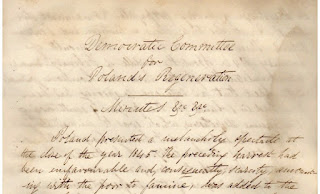
Minute book of the Democratic Committee for Poland’s Regeneration: an exciting Chartist discovery

Minute books are absolutely central to the collective memory of any organisation. They record who was there, what they discussed and agreed, often what financial assets they had, and what they decided to do to advance their cause. No less so the Chartist movement.

Extract from the minute book

Alas, of the many hundreds of minute books that must have at one time recorded the activities of local branches of the National Charter Association, its delegate bodies, its central executive and its satellite organisations, barely one has survived. So the news that the original hand-written minute book of the Democratic Committee for Poland’s Regeneration has come to light is hugely exciting.

The 62-page vellum-bound quarto notebook, hand-written by the prominent Chartist George Julian Harney, recorded the life of the committee between 1846 and May 1847. It includes a list of the 29 founder members, and of 70 later members, in alphabetical order by town of residence, followed by minutes of the committee’s meetings, and newspaper cuttings.

In addition to Harney, other leading Chartists involved in the committee included Feargus O’Connor, Ernest Jones, William Cuffay, Thomas Martin Wheeler and Philip McGrath. Among the European exiles taking part were the German radicals Karl Schapper and Heinrich Bauer, and BartÅ‚omiej Beniowski, a veteran of the 1831 Polish uprising and himself an active Chartist.

The story of the book’s discovery by the historian David Goodway (author of the classic London Chartism 1838-1848 [Cambridge University Press, 1982]) and of what it can tell us about the committee and its place in London radicalism is told in an article for Cairn International Edition by Fabrice Bensimon, Professor of Modern British History at the Sorbonne University. His article was translated by Adrian Morfee.

The full text of this fascinating article can be found (in English) here.

Saturday, 20 March 2021

Talking Chartism: the video is here

I recently spent a very enjoyable hour and a half chatting about all things Chartism with professional genealogist Natalie at Genealogy Stories. You can watch the first hour of our conversation below.


This was a completely unscripted and unplanned talk (at least on my part), so please excuse the ums and ahhs, and any stories I launched into before getting sidetracked.

In part two, which you can access through Natalie's website, we talked a little about what happened to Chartism after 1848, and rather more about some interesting Chartists, including William Cuffay and Susanna Inge.

On the whole, I am really pleased with how it came out - although there are so many things I didn't get round to talking about, and of course if I'd prepared an answer to every question I might well have looked at alternative interpretations of some events. 

Natalie herself did a great job, and was very easy to talk to. Do check out Genealogy Stories where she has a growing collection of interviews along with some other great family history resources.

Monday, 11 May 2020

Sir Francis Burdett, 1770-1844


Sir Francis Burdett was for many years a powerful advocate of parliamentary reform. As MP for Westminster after 1807, he was a strong supporter of Catholic emancipation and advocated a series of radical measures that would later be included in the People’s Charter.

But he was no Chartist. Following the Reform Act of 1832, the fifth baronet drifted away from his earlier convictions, fell out with his notoriously radical constituents, and in 1837 got himself elected for North Wiltshire instead, where he became a staunch Tory.

Friday, 10 May 2019

Peterloo and its place in the Chartist memory

Hunt Memorial - from the Northern Star (20 August 1842)
So much is being written about Peterloo in this bicentenary year that I am reluctant to pitch in. But I think it is worth commenting on the ways in which memories of the 1819 massacre were co-opted by the Chartists a generation later, and the lessons that they held for radicals 20 or 30 years on.

Peterloo was, of course, not just within living memory. Despite the massive political upheavals that took place in the intervening years, it remained fresh in the minds of those who had been there and those who had heard about it with a sense of horror, even at second or third hand in radical broadsheets and newspapers.

Down the years, Peterloo veterans and their supporters continued to commemorate both the anniversary of Peterloo – 16 August – and the birthday in November of “Orator” Henry Hunt, whose arrest had served as the pretext for the yeomanry cavalry charge that left as many as 18 dead and 650 badly injured.

Friday, 1 June 2018

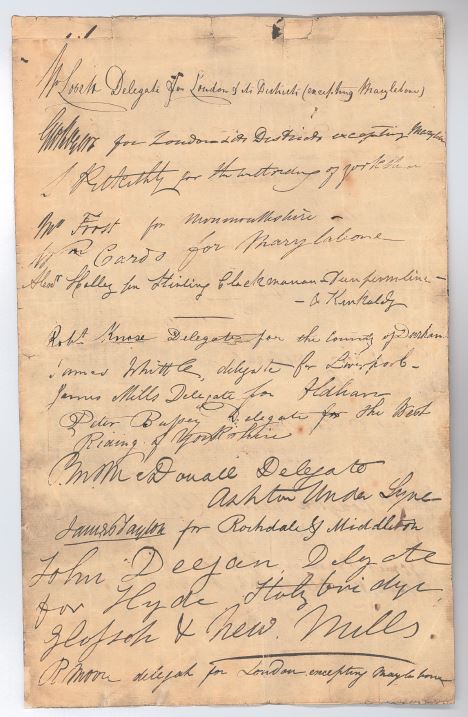
A list of Chartist leaders - but where did it come from, and when (and why) was it compiled?

My collection of Chartist ephemera now includes this intriguing four-page document. Entirely without preamble or explanation, it lists 44 of the best known figures in Chartism, their names apparently written in their own hand.

My first thought when I got my hands on it was that this was the delegate list for a conference taking place on 19 November 1841 - a date which appears very clearly on the final page.

However, with further investigation, that appears not to be the case, and I have to say that it is not entirely obvious when the list was created or why. What I do know, and some thoughts about what it might represent, are set out here.

Download a PDF showing the document in full.

Thursday, 2 February 2017

A shared view of the Chartists: L'Illustration and the Illustrated London News

It is interesting to note that the great Chartist rally of 10 April 1848 made news across Europe at a time when many European radicals had other things on their mind. This was, after all, the Year of Revolutions, during which, it has rather unfairly been suggested, other countries overthrew their monarchs and proclaimed constitutions while in Britain we organised a petition.

Friday, 15 April 2016

Feargus O'Connor on land purchases and the Chartist land bank manager who thought better of it

Feargus O’Connor was a prolific writer. For many years he penned weekly addresses to the Chartist readers of the Northern Star each of which ran for thousands of words. In addition, he engaged in political polemic with opponents and rivals, and wrote copious advice on agricultural practices for those who shared his interest in small-scale farming.

Thursday, 1 October 2015

67 Chartists who contested parliamentary elections

No political movement has gathered so much popular support and found so little voice in Parliament as Chartism.

The Chartist movement’s most reliable long-term advocate at Westminster was Thomas Slingsby Duncombe. And, for a few scant years from 1847 until 1852, Feargus O’Connor, owner of the Northern Star and Chartism’s central figure, served alongside him as MP for Nottingham.

Saturday, 11 July 2015

Feargus O'Connor's letter: deciphering a Chartist mystery

I recently came across and could not resist buying handwritten letter by the Chartist leader Feargus O’Connor dated 20 October 1838. The letter is badly water stained and carries a rusty mark from the paperclip which must have attached it to other papers for quite some time.