Showing posts with label Fabrice Bensimon. Show all posts

Thursday, 11 July 2024

Kennington 1848: the women in white bonnets, the man in the dustman's hat and the coachman

The daguerreotype images of the famous Chartist Kennington Common meeting on 10 April 1848 have fascinated historians since they first came to light in the Royal Collection in the mid-1970s. Though not the first crowd photographs, as is sometimes claimed, they are the first such pictures of a protest meeting, and they provide a real glimpse into this historic moment in time.

Professor Fabrice Bensimon, historian of the nineteenth century and a noted expert on the Chartist movement at Sorbonne Université, has spent many hours pouring over the two surviving daguerreotypes in an attempt to shed light on the people who made up the crowd. His research appears in a recent article in the Journal of Victorian Culture1.

Saturday, 11 March 2023

Chartists abroad: British migrant workers in 19th century Europe

Artisans Abroad: British Migrant Workers in Industrialising Europe, 1815-1870, by Fabrice Bensimon (Oxford University Press, 2023)

No self-respecting Chartist passing through Rouen in the mid 1840s (and there were more of them than you might think) could do so without visiting the Nailors’ Arms Inn. Set up by Thomas Sidaway and his son John, the pub was somewhere that British workers in France might read the Northern Star or make donations to help the victims of oppression back home. It was even the base for a branch of the Chartist land company.

The Sidaways were just one small part of a British working-class diaspora to be found in Europe in the decades after Waterloo. Their pub must have drawn its customers from among the thousands of British workers who either travelled to Europe with their employer for specific projects, or who had crossed the Channel on their own initiative in search of work.

In a new book, Artisans Abroad: British Migrant Workers in Industrialising Europe, 1815–1870, Professor Fabrice Bensimon provides a fascinating account of the men and women who made the journey and who played a decisive part in European industrialisation. As he writes: ‘They came from across Britain, but especially from industrialised areas such as South Wales, Staffordshire, Lancashire, Nottinghamshire, and the city of Dundee in Scotland. They worked in linen, cotton, lace, wool combing, the iron industry, machine-making, steamship manufacturing, and railway building.’

Chartists, of course, made up a small number of the total. There were no more than 104 subscribers in France to the land company. But even so, they appeared to maintain a lively political culture. There were active branches in Rouen, Calais and Boulogne, and probably short-lived organisations elsewhere. Thomas Sidaway, a radical since the days of Peterloo, was an important part of this France-based Chartist group, lecturing and organising meetings, and collecting subscriptions; but he was far from a lone voice.

I know Professor Bensimon, an historian of the nineteenth century at Sorbonne University, from his work on Chartism. He has spoken at previous Chartism Days, and a few years back was kind enough to host a Chartism Day in Paris. This current work is far wider in scope, however, drawing on a large and diverse archive of new sources to present the first history of the migration of British workers to the European continent in this era, and to uncover the stories of many migrant workers in a genuinely transnational labour history.

Better still, it is also available on open access, and a PDF of the entire book is free to download. Follow this link then click on the ‘open access’ button.


Wednesday, 22 December 2021

Minute book of the Democratic Committee for Poland’s Regeneration: an exciting Chartist discovery

Minute books are absolutely central to the collective memory of any organisation. They record who was there, what they discussed and agreed, often what financial assets they had, and what they decided to do to advance their cause. No less so the Chartist movement.

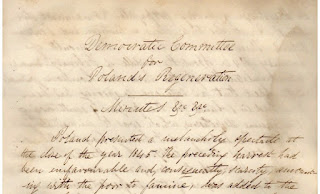
Extract from the minute book

Alas, of the many hundreds of minute books that must have at one time recorded the activities of local branches of the National Charter Association, its delegate bodies, its central executive and its satellite organisations, barely one has survived. So the news that the original hand-written minute book of the Democratic Committee for Poland’s Regeneration has come to light is hugely exciting.

The 62-page vellum-bound quarto notebook, hand-written by the prominent Chartist George Julian Harney, recorded the life of the committee between 1846 and May 1847. It includes a list of the 29 founder members, and of 70 later members, in alphabetical order by town of residence, followed by minutes of the committee’s meetings, and newspaper cuttings.

In addition to Harney, other leading Chartists involved in the committee included Feargus O’Connor, Ernest Jones, William Cuffay, Thomas Martin Wheeler and Philip McGrath. Among the European exiles taking part were the German radicals Karl Schapper and Heinrich Bauer, and BartÅ‚omiej Beniowski, a veteran of the 1831 Polish uprising and himself an active Chartist.

The story of the book’s discovery by the historian David Goodway (author of the classic London Chartism 1838-1848 [Cambridge University Press, 1982]) and of what it can tell us about the committee and its place in London radicalism is told in an article for Cairn International Edition by Fabrice Bensimon, Professor of Modern British History at the Sorbonne University. His article was translated by Adrian Morfee.

The full text of this fascinating article can be found (in English) here.