Showing posts with label chartist women. Show all posts

Tuesday, 24 September 2024

On the Elland Female Radical Association and the demography of women in Chartism

Dorothy Thompson was the first historian to write about Elland’s Female Radical Association, but the story of them rolling the local poor law commissioners in the snow before sending them on their way has ensured them at least a mention in pretty much every subsequent account of women in Chartism ever written.

I have now added an article on them to the website which focuses on their opposition to the New Poor Law, and their run-ins not just with the unfortunate poor law guardians but with the London press.

Thursday, 11 July 2024

Kennington 1848: the women in white bonnets, the man in the dustman's hat and the coachman

The daguerreotype images of the famous Chartist Kennington Common meeting on 10 April 1848 have fascinated historians since they first came to light in the Royal Collection in the mid-1970s. Though not the first crowd photographs, as is sometimes claimed, they are the first such pictures of a protest meeting, and they provide a real glimpse into this historic moment in time.

Professor Fabrice Bensimon, historian of the nineteenth century and a noted expert on the Chartist movement at Sorbonne Université, has spent many hours pouring over the two surviving daguerreotypes in an attempt to shed light on the people who made up the crowd. His research appears in a recent article in the Journal of Victorian Culture1.

Sunday, 23 June 2024

Emma Miles: the life of a female Chartist activist

Born in 1819, Emma Miles was one of a number of female activists in their early twenties who made the City of London Female Chartist Association something of a media sensation with their unashamed views on political reform and the place of women in public life.

The daughter of a well known London clockmaker (whose work today sells for thousands of pounds and can be found in museums), Emma dismissed the very idea that women should be content to be ‘an ornament to the domestic hearth’ and declared that she would remain a Chartist to the end of her life.

Emma would later marry a fellow Chartist activist and emigrate to Ohio.

I’ve been digging into Emma’s story a little after identifying her with some certainty in the baptism and marriage records to be found on Ancestry (others sharing her name being too young or too old, too far from London, or too married). 

Frustratingly, however, I have not yet managed to identify the right Mary Ann Walker in the records. 

Emma’s life story can be found here.

Tuesday, 9 April 2024

More names for the Chartist Ancestors databank

I have added another 150 names to the Chartist Ancestors databank. This takes the total to 14,381.

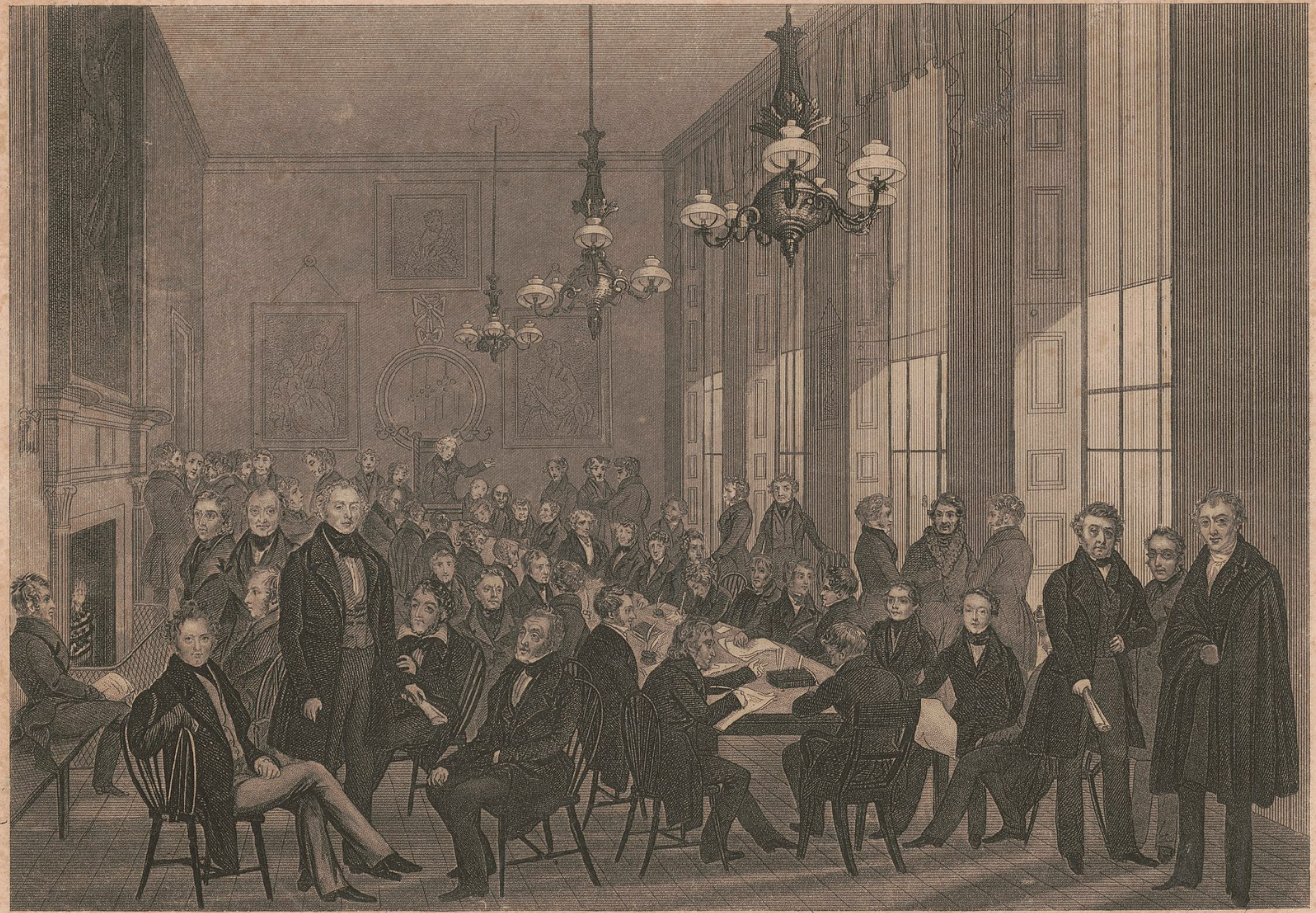
Delegates to the first Chartist convention, meeting
at the British Coffee House, 4 February 1839.
The latest batch includes the names of all those elected as delegates to the General Convention of the Industrious Classes (the first convention) in 1839, whether or not they took up their seats.

I have also added the officers and councils of both the Carlisle Radical Association and the Carlisle Female Radical Association. Cumberland (as it then was) and Carlisle in particular are interesting Chartist centres, but to the best of my knowledge have not been properly studied. 

Friday, 22 March 2024

In search of Helen Macfarlane: the elusive ‘shooting star’ of Chartism

Red Antigone: The Life and World of Helen Macfarlane, by David Black (BPC Publishers, 2024)

On a spring day in 1860, parishioners at the tiny fourteenth-century church at Baddiley, deep in the heart of the Cheshire countryside, gathered for the funeral of the vicar’s wife. Helen Edwards had died after a short illness aged just 41, and was laid to rest in the churchyard at St Michael’s in a peaceful spot in the shade of a large and now quite ancient tree.

Friday, 22 December 2023

Chartist women at a delegate conference, 1841

The Chartist national delegate meeting that assembled in York at the end of August 1841 was not faced with the most difficult of agendas. The sole purpose for which it had been called was to welcome Feargus O’Connor on his release from prison and to draw up a suitable address as just one element in the festivities greeting the release of ‘the liberated patriot’.  

Even so, more than seventy delegates took part in the meeting, largely from the North of England, but some from as far afield as London and Dumfries. And most notably of all, their number included Mrs Elizabeth Ellis and Mrs Elizabeth Sumper, representing ‘Bradford Females’ (Northern Star, 4 September 1841, p6).
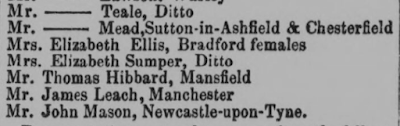
Part of the delegate list carried in the Northern Star.

There is unfortunately no record of anything either of them may have said at the meeting. But the very fact of them being there makes this conference unique: although there were many Female Charter Associations all over the country, there is no other recorded instance in which such societies were represented at a delegate event, regional or national. Intriguingly, there were no representatives of the Bradford men at the meeting. 

The Bradford women were clearly numerous and well organised. In August 1839, the Northern Star reported that ‘the female radicals of the Bradford district, amounting to upward of 600, walked in procession through the principal streets’ led by a woman carrying a large printed board on which were printed the words ‘exclusive dealing’.

Unfortunately neither Mrs Sumper nor Mrs Ellis is mentioned again in fifteen years’ worth of the Northern Star, and neither have I located either of them in census or other official records. But it seems likely that Elizabeth Ellis would have been married to George Ellis, the Bradford news-agent and vendor of the Star whose name appears from time to time in the paper. This, then, would have been a Chartist household – and quite likely a teetotal one, because in the spring of 1841, George Ellis of Manningham near Bradford, secretary of the Teetotal Chartist Association, also put his name to the Temperance Address initiated by Henry Vincent (NS, 20 March 1841, p3).

If anyone knows anything more of Mrs Sumper or Mrs Ellis, please let me know!

Friday, 20 January 2023

The life story of May Paris, Chartist activist

There are around thirty Chartist life stories on the Chartist Ancestors - and over the past few days I have been able to add a few more. 

My favourite among the new additions is a short biographical piece on May Paris, who died at the age of just 42 in the cholera epidemic that swept London in 1849. Though little known outside her immediate circle of family and friends, it is thanks to her and many like her that the Chartist movement was able to sustain itself and make its voice heard. From the limited sources that survive, it is obvious that she must have been a dedicated and active political radical.

It’s especially pleasing to have been able to write about May Paris as it can be next to impossible to resurrect the stories of working-class women from this era. Read more about May Paris.

I have also restored a number of short biographical pieces which were formerly on the site but were lost in various builds, rebuilds and site moves. These include the stories of George Binns from Sunderland, and Anthony Cavalier of Sheffield.

Saturday, 20 March 2021

Talking Chartism: the video is here

I recently spent a very enjoyable hour and a half chatting about all things Chartism with professional genealogist Natalie at Genealogy Stories. You can watch the first hour of our conversation below.


This was a completely unscripted and unplanned talk (at least on my part), so please excuse the ums and ahhs, and any stories I launched into before getting sidetracked.

In part two, which you can access through Natalie's website, we talked a little about what happened to Chartism after 1848, and rather more about some interesting Chartists, including William Cuffay and Susanna Inge.

On the whole, I am really pleased with how it came out - although there are so many things I didn't get round to talking about, and of course if I'd prepared an answer to every question I might well have looked at alternative interpretations of some events. 

Natalie herself did a great job, and was very easy to talk to. Do check out Genealogy Stories where she has a growing collection of interviews along with some other great family history resources.

Friday, 7 June 2019

Chartism Day 2019: from electoral strategy to votes for women, via loaded juries and Yorkshire miners

During the first wave of Chartism, Newcastle was home to the radical Northern Liberator newspaper, and would see some of the largest monster meetings of the age.

Some 180 years later, the city played host once again last weekend to Chartism Day – the annual gathering of academic, unaffiliated and local historians whose shared interests ensure Chartism remains a lively and active field of history.

Wednesday, 9 May 2018

Big upgrade to the Chartist Ancestors Databank

The Chartist Ancestors Databank has had a major update. Thanks to the addition of a three big new data sets listing Chartist women, Londoners and France-based Chartists, the running total of names now exceeds 14,000.

You can find out more about the Chartist Ancestors Databank and download the full databank itself in Excel format here.

Wednesday, 23 August 2017

Analysing the Chartist Land Company registers


In his second guest blog post, Peter Cox explores the occupations and locations of Chartist Land Company subscribers uncovered by a U3A project to transcribe the identities of Londoners and women found in the original documents held at the National Archives.

I have already explained what led to a group of seventy-somethings trekking to Kew on and off for three months. We were transcribing all the Londoners and women who subscribed to the Chartist Land Company, which meant painstakingly combing through three massive volumes containing thousands of lines of name, address and occupation.

Now we’ve completed the job, we’ve been able to analyse what we found.

Wednesday, 23 March 2016

City of London female Chartists divided

So much information has now come to light about the City of London Chartist Susanna Inge that I have had had to reorganise a whole section of the Chartist Ancestors website, creating three pages where once there was one.

Friday, 11 March 2016

Susanna Inge: photo and letters of a female Chartist

Susanna Inge and Mary Ann Walker of the City of London Female Charter Association have always been fascinating characters in the Chartist story – not least for their willingness to stand up for women’s right to a political voice.

But as with so many Chartists, their involvement with the movement represented just one episode of their lives.

Neither was previously known to have had any political involvement, and both disappeared back into obscurity after no more than two years in the spotlight. So where did they come from, and what happened to them in later life?

Thursday, 7 January 2016

Susanna Inge: a life after Chartism

Susanna Inge and Mary Ann Walker occupy a walk-on part in numerous histories of Chartism and of women’s involvement in 19th century radical politics.

They were the leading lights in launching the City of London Female Chartists Association, and for a few months their willingness to confront head-on the disapproval and downright misogyny directed against the idea of women’s involvement in politics earned them a certain degree of infamy.

Wednesday, 17 April 2013

What became of Helen Macfarlane? A Victorian mystery solved at last

Few knew her identity at the time, and fewer still remembered her in the years that followed, but Helen Macfarlane was probably the most influential woman in the Chartist movement.

Writing under the name Howard Morton, Macfarlane made the first English translation of the Communist Manifesto, which appeared in George Julian Harney’s Red Republican in 1850, and was described by Karl Marx as “the only collaborator on his spouting rag who had original ideas”.

Thursday, 22 November 2012

Helen Macfarlane - a woman with a past

In 1850 a shooting star crossed the skies of Revolutionary Europe - Helen Macfarlane. A radical journalist hanging out with Karl Marx and Frederick Engels in Soho, the star columnist of Chartist newspaper The Red Republican who wrote under the pen-name Howard Morton, the first translator of the Communist Manifesto into English.

Karl Marx admiringly said of her that she was the only one on the paper who had any original ideas. But when the jealous Scottish wife of her editor turned on her and mortally insulted her - Helen walked out, never to be seen by history again. No-one knew where she came from and no-one knew where she went to.

David Black and Louise Yeoman have changed that. At first working independently and then together, they found that Helen came from Barrhead just outside Paisley. They found her family's business and Scottish background - and the personal catastrophe that may have set her on the road to radicalism.

Helped by South African historian Shelagh Spencer, they traced Helen's Scottish family to South Africa. Helen married a refugee from the revolutions - Frederick Proust and then she pitched up in Cape Town, minus her husband who jumped ship, but with a short-lived baby named like a manifesto - poor wee Consuela Pauline Roland Proust - named after a feminist character in a novel and a radical French feminist political prisoner.

Within a few days of the traumatic voyage the baby died. Helen, broken-hearted and maybe out of place in the young colony couldn't stay there. What became of her? A radio programme for BBC Scotland reveals her utterly surprising fate. You'll never guess where she ended up.

WOMEN WITH A PAST – HELEN MACFARLANE
BBC SCOTLAND
Monday 26 November 2012 14.05 pm
Presented by Susan Morrison

See also David Black's Helen Macfarlane: A Feminist, Revolutionary Journalist, and Philosopher in Mid 19th Century England

Friday, 2 March 2012

45 Scottish women Chartists

A database of 45 women who were active in the Chartist movement in Scotland has now been added to Chartist Ancestors. Here is the page.
Women played a big part in Chartism. Although none of the Chartist petitions called for women to be given the vote, up to 20% of those adding their names in some parts of the country were women.
They also organised themselves in Female Chartist Associations – some 23 of which are known to have existed in Scotland alone, as well as taking part in an enormously wide range of other activities, from the domestic to the public political sphere.
Yet this is an enormously hard subject to research. There has been no major new work on Scottish Chartism since the start of the 1970s, and academic study of women's part in Chartist agitation is still less well served.
I am therefore indebted and grateful to Sue John, who researched and compiled the database of Women Chartists in Scotland and kindly permitted its publication on Chartist Ancestors.

Scottish Chartism on the map

Chartism in Scotland was largely a product of the central belt, running across the country from Greenock on the West coast, through Glasgow and Edinburgh, and on up to Dundee on the East of the country.
This is hardly surprising as most of Scotland's population was found here in the 1840s (when it was known as the Scottish Midlands) just as it is today.
However, the extent to which Chartism was a central belt phenomenon becomes very obvious when shown on a map.
Alexander Wilson compiled lists of Chartist associations, female Chartist associations, Chartist churches and Chartist co-operative societies for The Chartist Movement in Scotland (Augustus M Kelley Publishers, 1970).
I have now taken these lists and created two Google Maps with them. The first shows local Chartist associations; the second shows female associations, churches and co-operative societies.
To get a sense of the spread of Chartism in Scotland, it is necessary to open the maps and get larger versions. Sometimes it is possible to see a string of towns along a main road, each with its own Chartist body. Perhaps this reflects the success of a particular Chartist missionary on his travels. No doubt other patterns will also emerge.
In due course, I will add both maps to the Chartists in Scotland page on Chartist Ancestors. But both are shown below for now.

View Larger Map  
View Larger Map

Two Chartist women lecturers

Susanna Inge and Mary Ann Walker were, briefly, prominent speakers on the London Chartist lecture circuit.
Yet almost nothing is known of the "she Chartists", as they were disparagingly dubbed by The Times, beyond a few speeches that they made over a 12-month period from July 1842 to the summer of 1843.
The story of their rise to heady mix of popular acclaim and newspaper condemnation – and of their equally rapid disappearance from public view – has now been added to Chartist Ancestors.
I personally enjoyed the newspapers' account of the previously unknown Mary Ann Walker's unscripted demolition of a male speaker who suggested that women were unfit for public office since they might be unduly influenced by a male suitor of opposing views.
It is interesting to speculate on what might have been had the Chartist movement taken the political rights of women more seriously (and been less inclined to dismiss women who had the audacity to challenge its leaders).
I would also love to know more about what happened to Susanna Inge and Mary Ann Walker when they dropped out of the Chartist movement. If you can fill in any of the gaps, please do get in touch.
Meanwhile, I also plan to publish more about women Chartists on the website in the coming months.