Showing posts with label chartist convention. Show all posts

Tuesday, 9 April 2024

More names for the Chartist Ancestors databank

I have added another 150 names to the Chartist Ancestors databank. This takes the total to 14,381.

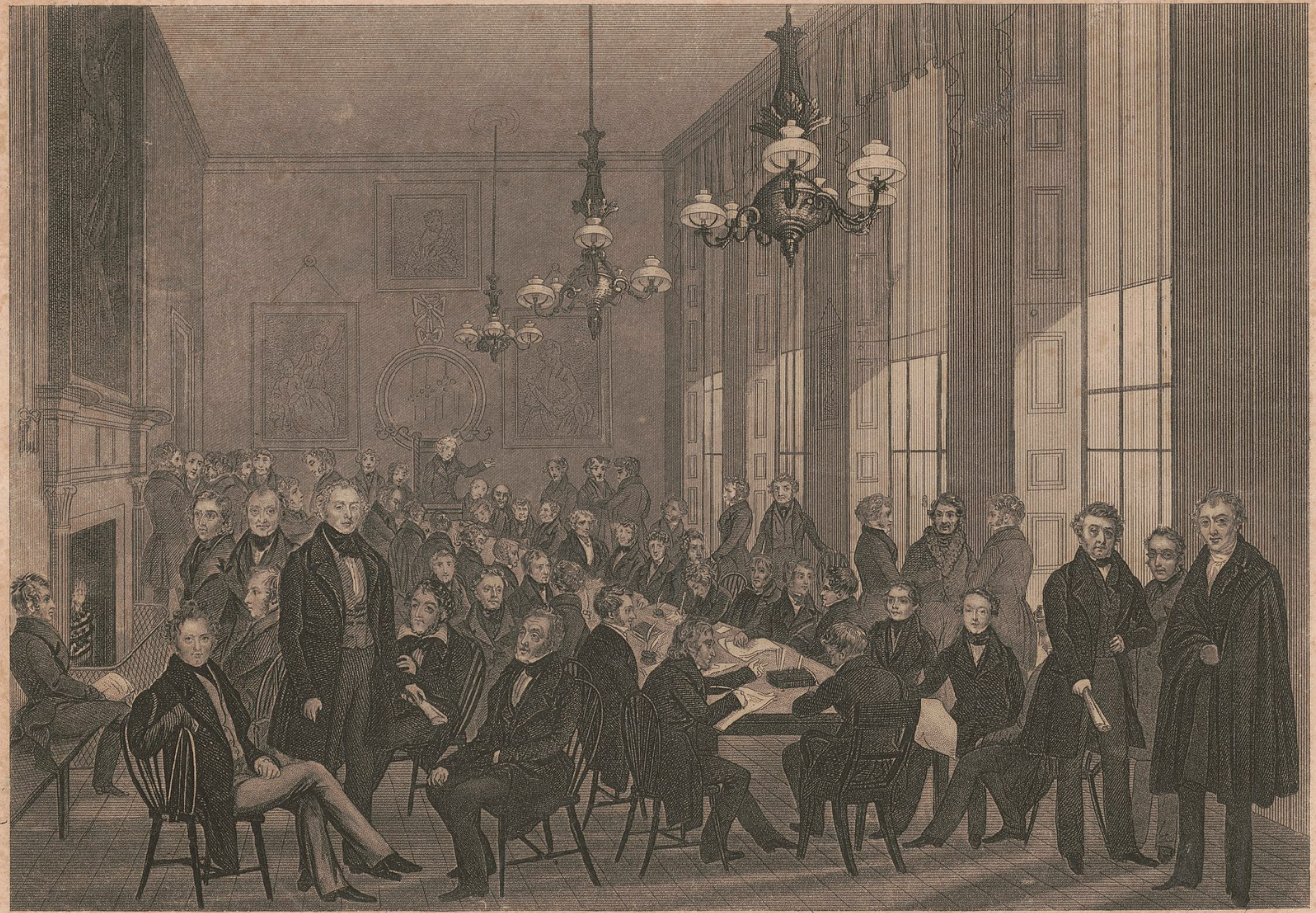
Delegates to the first Chartist convention, meeting
at the British Coffee House, 4 February 1839.
The latest batch includes the names of all those elected as delegates to the General Convention of the Industrious Classes (the first convention) in 1839, whether or not they took up their seats.

I have also added the officers and councils of both the Carlisle Radical Association and the Carlisle Female Radical Association. Cumberland (as it then was) and Carlisle in particular are interesting Chartist centres, but to the best of my knowledge have not been properly studied. 

Saturday, 20 March 2021

Talking Chartism: the video is here

I recently spent a very enjoyable hour and a half chatting about all things Chartism with professional genealogist Natalie at Genealogy Stories. You can watch the first hour of our conversation below.


This was a completely unscripted and unplanned talk (at least on my part), so please excuse the ums and ahhs, and any stories I launched into before getting sidetracked.

In part two, which you can access through Natalie's website, we talked a little about what happened to Chartism after 1848, and rather more about some interesting Chartists, including William Cuffay and Susanna Inge.

On the whole, I am really pleased with how it came out - although there are so many things I didn't get round to talking about, and of course if I'd prepared an answer to every question I might well have looked at alternative interpretations of some events. 

Natalie herself did a great job, and was very easy to talk to. Do check out Genealogy Stories where she has a growing collection of interviews along with some other great family history resources.

Friday, 1 June 2018

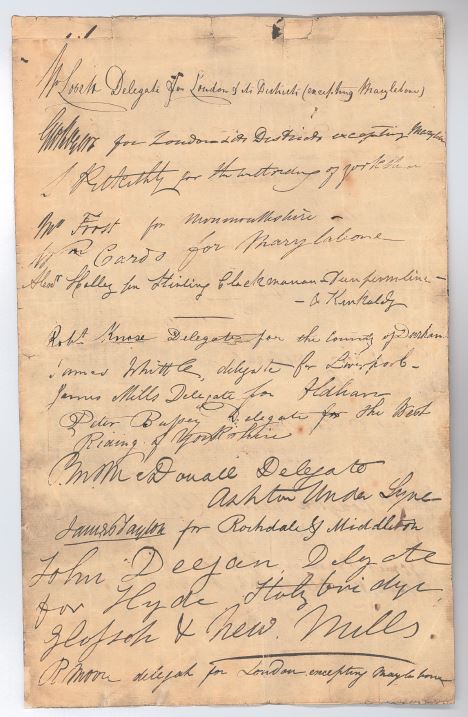
A list of Chartist leaders - but where did it come from, and when (and why) was it compiled?

My collection of Chartist ephemera now includes this intriguing four-page document. Entirely without preamble or explanation, it lists 44 of the best known figures in Chartism, their names apparently written in their own hand.

My first thought when I got my hands on it was that this was the delegate list for a conference taking place on 19 November 1841 - a date which appears very clearly on the final page.

However, with further investigation, that appears not to be the case, and I have to say that it is not entirely obvious when the list was created or why. What I do know, and some thoughts about what it might represent, are set out here.

Download a PDF showing the document in full.

Thursday, 26 September 2013

South Wales Chartist Convention set for 2 November 2013

The South Wales Chartist Convention (hosted by the new University of South Wales ) is being held on Saturday 2nd November 10.15 - 16.15 at the university's City Campus, Newport.

Full details of the agenda and how to book are set out below. Entry is free, but you must book to secure a place.

The main speaker this year is Professor Angela V. John (Aberystwyth University). She will be speaking about the remarkable Margaret Thomas of Llanwern House, Newport - militant suffragette and feminist campaigner, who inherited her father's title in 1920, but was refused entry to the House of Lords.

Friday, 2 March 2012

John Skevington: Leicestershire Chartist

Our current series of Chartist portraits finishes with John Skevington, the working class radical leader from Leicestershire who represented both Derby and his home town of Loughborough in the First Chartist Convention of 1839.

The series ends here because this is the point at which The Charter newspaper drew to a close its own run of 12 profiles of delegates to the First Chartist Convention (more properly, the General Convention of the Industrious Classes).

A profile of John Skevington, based on the sketch and brief biography which first appeared in The Charter of 19 May 1839, can now be found on Chartist Ancestors

Skevington was among the most capable and committed of the local working class leaders thrown up by Chartism. Already an established radical figure in Loughborough at the beginning of the Chartist era, he would go on through thick and thin to serve the movement until his death in 1850.

It can hardly have been easy to be a prominent Chartist in that county. Tensions between Thomas Cooper, a Wesleyan Methodist preacher and journalist who arrived in Leicester in late 1840, and the town’s more established radical leadership were disastrous.

For a period, there were two Chartist factions which held separate meetings at different venues. Skevington, however, appeared to retain sufficient good will among both groups to be asked to chair a meeting at which the two sides could air their differences.

Although Skevington played little enough part on the national political stage after 1839 (other than as a conference delegate), his commitment to the cause earned him the respect of thousands who flocked to the Chartist banner in Leicestershire.

Peter Bussey: exiled revolutionary

Peter Bussey was everything the originators of the People’s Charter disliked and feared about the mass of disgruntled and distressed working people who flooded into Chartism.

While the careful and politically astute artisans of the London Working Men’s Association were natural behind-the-scenes influencers of politicians and government, Bussey, a Bradford innkeeper, was blunt, confrontational and had little time for a gradualist approach. 

His approach went down well with a working class suffering from an economic crisis, dispossessed by the increasing mechanisation of mills and factories, excluded from political influence by the 1832 Reform Act, and threatened with the workhouse by the New Poor Law.

A page based on The Charter’s profile of Peter Bussey now appears on Chartist Ancestors. 

As far back as the agitation of 1831 and 1832, Bussey had appeared to see little benefit in compromise, opposing the Reform Bill because of its failure to extend the vote for all rather than supporting it as the best obtainable measure at the time.

By the time the LWMA-friendly Charter newspaper came to profile him as the West Riding’s delegate to the First Chartist Convention of 1839, he was firmly on the physical force wing of Chartism. And when Parliament rejected the great Chartist petition of that year, he was one of those who conspired for a general uprising that would take a swathe of England and Wales from Tyneside to Newport by storm.

When the day came, however, Bussey was nowhere to be found, and as the uprising faltered, he fled to America, where he would remain a political exile for 14 years. 

In the fullness of time and after some hard times in and around New York, Bussey returned to Bradford, where he settled down to raise a family and to run a public house once again. He died in 1869, and his gravestone can still be seen in Farsley churchyard.

William Lovett born 8 May 1800

Chartist anniversaries fall thick and fast in May. On 7 May 1839, the first Chartist petition was presented to Parliament, and today is the birthday of William Lovett, the man who wrote the text of the People’s Charter and served as secretary to the First Chartist Convention of 1839.

Lovett was born at Newlyn near Penzance. His father died at sea before William was born, so he was brought up by his mother, aunt and grandmother in a strict Methodist household. Moving to London in 1821 if not earlier, he became active in radical politics.

Lovett played a part in early trade unionism, the co-operative stores movement and other causes, refused to serve in the militia – at some personal cost – and joined the National Union of the Working Classes.
It was on his initiative that the London Working Men’s Association was founded in 1836 and it was this body from which the Charter emerged.

In truth, there was nothing new about the Six Points, all of which had long been part of the radical canon. Neither did Lovett or the LWMA organise the famous petition to Parliament (this originated with the Birmingham Political Union).

And, had the organisation of Chartism been left to Lovett and his LWMA comrades, it is likely that it would scarcely merit a footnote in the history books. They were unable even to print copies in time for its launch.

But Lovett was a man of great principle, who went to prison for his Chartist activities and played an honourable if not always effective part in the radical politics of the day. Lovett died on 8 August 1877, and is buried in Highgate Cemetery.


Robert Lowery: Newcastle Chartist

Robert Lowery lived an extraordinarily full political life for a man who died at just 54 years of age.
Born in 1809, he first became active in radical politics as secretary to the Newcastle Political Union during the Great Reform Act agitation of 1831 and 1832. By the time of his death in 1863, he had become a mainstream Gladstonian Liberal.
It is, however, his years of service to the Chartist movement that are of interest here, and a page on Robert Lowery, based on the profile published by The Charter during his time as delegate to the First Chartist Convention, now appears on Chartist Ancestors.
When the Convention was called early in 1839, few Chartists believed that Parliament would bow down to public opinion once the first petition was presented and concede to Chartism’s Six Points.
Lowery was among those who advocated “ulterior measures”, arguing for a “sacred month”, or general strike, as a way of forcing the point. He also knew in advance of the armed uprisings planned for November 1839 which ended so tragically for the Chartists in Newport.
Biographies of Lowery appear both in The Dictionary of Labour Biography (volume 4) and in more detail in the 1980 book Robert Lowery: Radical and Chartist, edited by Brian Harrison and Patricia Hollis.

Thomas Rayner Smart: veteran Chartist patriot

Thomas Rayner Smart was a largely self-taught working man whose scruffy greatcoat and battered hat marked him out from the generality of middle-class delegates to the First Chartist Convention of 1839.

While representing Loughborough and Leicester at the convention, Smart was profiled by The Charter newspaper. Both the profile and a portrait sketch which accompanied it now appear on Chartist Ancestors.

Very little appears to have been written about Smart, and in tracking him down in the 1841 census and through mentions in the Chartist press to add a little more detail to his life story, I was also pleased to uncover some information about his daughter.

She is named only as “Mrs Cully” in a Northern Star account of the setting up of a Female Chartist Association in Leicester in 1848. But BMD records and the census reveal her full name to have been Caroline Augusta Smart.

Apparently born around 1801 (the 1841 census gives her age as 40, but frequently rounded ages to the nearest five years), she had married Joseph Culley in 1837. 

The couple also appear to be present in the 1851 census (Caroline’s age here given as 47 – so, perhaps, unrounded her date of birth was nearer 1805). However, there appear to be no children from the marriage, and no sign of either Joseph or Caroline in 1861.

William Villiers Sankey - a Chartist aristocrat

William Villiers Sankey came from aristocratic stock. The son of an Irish volunteer and Member of Parliament, he moved among the political elite of his day. Yet he also served as a delegate to the First Chartist Convention of 1839.
While representing Edinburgh at the convention, Sankey was profiled by The Charter newspaper. Both the profile and a portrait sketch which accompanied it now appear on Chartist Ancestors.
Sankey appears to have been a fiercely clever young man who considered the law, the church and medicine as potential careers before settling on a life as a professor of mathematics. He had also shown an aptitude for Ancient Greek and Hebrew studies.
As a convention delegate, Sankey proved to be somewhat erratic, voicing hard-line views before retreating to a moral force position as the convention went on.
However, his sympathy for the Chartist cause outlasted the first flush of enthusiasm, and he was still politically active in the early 1840s, all the while contributing his thoughts on mathematics and other subjects to specialist publications.
In Friends of the People: The Uneasy Radicals in the Age of the Chartists Owen Ashton and Paul Pickering focus on six middle class Chartist leaders, among them William Villiers Sankey. Order this book online.

Peter McDouall: Chartist hero

Peter Murray McDouall, a Scottish-born doctor radicalised by his exposure to factory conditions in industrial Lancashire, was one of the most significant figures in Chartism for a decade.
Gaoled twice, losing a daughter during one period of imprisonment due to the terrible conditions suffered by his family, and dying at a young age, it is not too much to say that McDouall (whose name is usually given in publications of the time as M’Douall) gave his life for Chartism.
While serving as a delegate to the First Chartist Convention of 1839, where he represented  Ashton-under-Lyne, McDouall was profiled by The Charter newspaper. Both the profile and the sketch portrait that accompanied it now appear on Chartist Ancestors.
McDouall was a romantic figure.
The Chartist historian Robert Gammage described him as “decidedly handsome”, with his hair in “long graceful curls”. He supplemented his looks, according to WE Adams, with “a long cloak and a style which “helped to give him the appearance of a hero of melodrama”.
But he was also a serious political leader, being an early advocate of a general strike as a weapon to win the Charter following the rejection of the first Chartist petition, and a self-proclaimed supporter of the use of physical force should it prove necessary.
In addition to two periods of imprisonment, McDouall would also endure two years' political exile in France, where he lived on the goodwill of Chartist supporters. Unable, eventually, to build his medical practice because of his political involvement, he finally emigrated to Austrialia, where he died at the age of just 40.

Robert Knox: Chartist convention delegate

Robert Knox must have been one of the youngest delegates to the First Chartist Convention of 1839. He was just 24 years old when his profile appeared in The Charter newspaper.
That profile, and the sketch portrait of Knox that appeared in the same paper, now appears on Chartist Ancestors as part of a small-scale project to reproduce the 12 delegate biographies that The Charter ran during the Convention.
Knox served as the delegate for County Durham, and lived in Sunderland at the time. However, he was a Scot, born according to The Charter at Dunse in the county of Berwick.
It is possible that he returned to Scotland in later life. The 1891 census records a Robert Knox, born in approximately 1813 at Duns, Berwickshire, then living at 19 Gowrie Street, Kinnoull, Perthshire.
Was this the same man? The Charter described Knox in 1839 as a slater, while the 1891 census has him as a retired sadler. The discrepancy could have a number of explanations, and the coincidence of name, age and birthplace suggests this may be our man. But it is difficult to be sure.

Chartism's great class divide

There is now a page on Chartist Ancestors listing some 400 delegates to a joint conference of the National Charter Association and Complete Suffrage Union, held in December 1842.
This page has been on the site for some years, but lacked around 100 names. Happily, I have now been able to add them to the list, along with a profile of Joseph Sturge (pictured) and his Complete Suffrage Union. The delegates’ list also records their position on the key votes.
Chartism was always an uneasy alliance of different interests and organisations, so with the rejection of the first petition in 1839 and the authorities’ heavy-handed crackdown on the movement’s local and national leaders, it is no surprise that there were splits in the Chartist ranks.
The faction around Feargus O’Connor concluded as a result of that year’s events that there was a need for both a mass movement and a more centralised layer of organisation – and created the National Charter Association.
O’Connor dealt firmly with anything he saw as creating divisions, turning his ire on Church Chartism, Teetotal Chartism, so-called Knowledge Chartism and those who set up rival bodies to the NCA.
His appeal to middle class reformers was limited, however, and it was the Quaker and anti-slavery campaigner Joseph Sturge who filled the vacuum, establishing the Complete Suffrage Union in November 1841. This organisation, which committed itself early on to all six points of the Charter, would also provide a rallying point for opponents of O’Connor among the Chartists.
Following the rejection of the second Chartist petition in 1842, efforts were made to unite the NCA and CSU. These efforts foundered on questions of tactics and leadership (not to mention personality) but were brought to a head by the use of the word “Chartist”.
Sturge and the CSU believed the term to be too loaded violent associations to appeal to a middle class constituency; O’Connor and the NCA – backed by William Lovett and others who had no great love for O’Connor – were not prepared to budge.
The December 1842 conference called to try to unite the two factions ended with Sturge and his supporters walking out, and in the ascendancy of the NCA.
In due course, Sturge and his middle class reformers would turn their attentions to corn law repeal. For O’Connor, the rallying cry would be “the Charter and nothing less”.
First Chartist convention, 1839

The first Chartist Convention opened in London on 4 February 1839 – a date carefully chosen to coincide with the start of a new parliamentary session.
The Convention brought Chartist delegates to the capital from across the country, and its purpose was far more than simply to organise the delivery of the monster petition Chartists had gathered in support of the six points.
With an “electorate” of hundreds of thousands at their backs, delegates could claim a political legitimacy to rival that of the undemocratic Commons to which the petition would be presented, and they sought to speak on behalf of the country.
This was a potentially revolutionary alternative to Parliament. Its opening stages, however, would do little to reinforce such an impression.
Delegates to the General Convention of the Industrious Classes, to give the assembly its full title, initially gathered at Brown’s Hotel in Westminster Palace Yard – only to discover that the venue was double-booked for the inaugural conference of the Anti Corn Law League.
They then moved on to the British Coffee House at Cockspur Street, where they spent a cramped few days before finding a home at the Honourable and Ancient Lumber Troop, a radical drinking club in Bolt Court off Fleet Street.
Above: Delegates to the Convention.