Showing posts with label memorabilia. Show all posts

Friday, 18 August 2023

Three Chartist tankards: make mine a quart

 'Lot 473. A set of three graduated personalised pewter tankards engraved with the symbol of the Chartists'.

A larger version of this and other pictures can be found at the link below.

Over the years it has become more and more difficult to find Chartist memorabilia up for sale. So when I spotted these at auction I had to have them.

Slightly dented, and tarnished with age (and aren't we all), these three engraved pewter tankards are a solid link back to the days when men and women turned out in their thousands to hear big name speakers spread the message of Chartism at great monster meetings.

After all, what better way to thank the speaker than by presenting them publicly with a keepsake of their visit to your town which stressed the readiness of its radical population to fight for the Charter.

I have written about the tankards, what I think they are and what I think the inscription tells us on the Chartist Ancestors website. Go here to read it.

Saturday, 20 March 2021

Talking Chartism: the video is here

I recently spent a very enjoyable hour and a half chatting about all things Chartism with professional genealogist Natalie at Genealogy Stories. You can watch the first hour of our conversation below.


This was a completely unscripted and unplanned talk (at least on my part), so please excuse the ums and ahhs, and any stories I launched into before getting sidetracked.

In part two, which you can access through Natalie's website, we talked a little about what happened to Chartism after 1848, and rather more about some interesting Chartists, including William Cuffay and Susanna Inge.

On the whole, I am really pleased with how it came out - although there are so many things I didn't get round to talking about, and of course if I'd prepared an answer to every question I might well have looked at alternative interpretations of some events. 

Natalie herself did a great job, and was very easy to talk to. Do check out Genealogy Stories where she has a growing collection of interviews along with some other great family history resources.

Tuesday, 26 February 2019

A Rye request for women canvassers

In 1867, the Liberal MP John Stuart Mill moved an amendment to the Reform Bill which would have given the vote in parliamentary elections to women. It was defeated by 196 votes to 73.

But while politicians continued to resist women’s suffrage for a further half century or more, they were clearly happy to call on women’s help in getting elected provided that they confined themselves to cheer-leading on behalf of male parliamentary candidates.

Wednesday, 28 November 2018

Britannia and liberty: a message of hope for the Chartists?

Commemorative medals or medallions were commonly issued throughout the 19th century to mark great radical causes and events.

The 1832 Reform Act in particular produced medallions in a wide variety of styles and designs, as did Gladstone’s Reform Act of 1889. However, there appear to be relatively few relating to Chartism.

I am no numismatist, but I was only previously aware of the two Feargus O’Connor medallions – one marking the launch of his Northern Union in 1838, and the other celebrating his release from gaol in 1841.

However, I recently came across this more generic example dated 1842, which is clearly intended to mark the defeat of Chartism in 1842, following rejection of the second great petition for the Charter and the arrest of numerous local and national Chartist leaders.

The question is, what message does it send? I bought this on eBay from a US dealer who described it as “Anti-Chartist”. But I’m not so sure.

On the obverse, under the heading “To-day”, Britannia lies prostrate on the floor. To one side, a mounted cavalry officer, sabre drawn, tramples a banner marked “The Charter”. To the other, a bishop with his crook and what appear to be two robed judges armed with swords, one of whom holds a scroll engraved “Law”, tread a banner marked “Liberty”. At the bottom of the coin are the words “Britannia oppressed 1842”.

On the reverse, under the heading “To-morrow”, Britannia is triumphant, standing sword in hand in front of a scroll marked “The Charter”, which in turn lies across a box or stand inscribed with “Justice”. She is assisted by an armed man who holds the defeated bishop at sword point, while the judges flee, apparently praying for deliverance. The inscription at the bottom reads “Britannia triumphant”.

I think these images, taken as a pair, can only be read as anti-Chartist if Britannia is associated with the forces of reaction and the state. Why else look forward to a day when she triumphs? But even then, the roles played by the cavalryman, bishop and judges simply don’t fit the narrative.

But Britannia was never a purely conservative figure. Rather, she was associated with liberty, and appealed symbolically to the radical cause (not least as a British counterpart to the revolutionary French Marianne).

On this reading, Britannia is the people – or, more abstractly, the people’s liberty – oppressed “to-day” by church and state, but certain to overcome her oppressors “to-morrow”.

In other words, the medallion is not anti-Chartist; rather, it offers a message of hope for the temporarily defeated Chartist movement in 1842 – victory will come.

Friday, 1 June 2018

A list of Chartist leaders - but where did it come from, and when (and why) was it compiled?

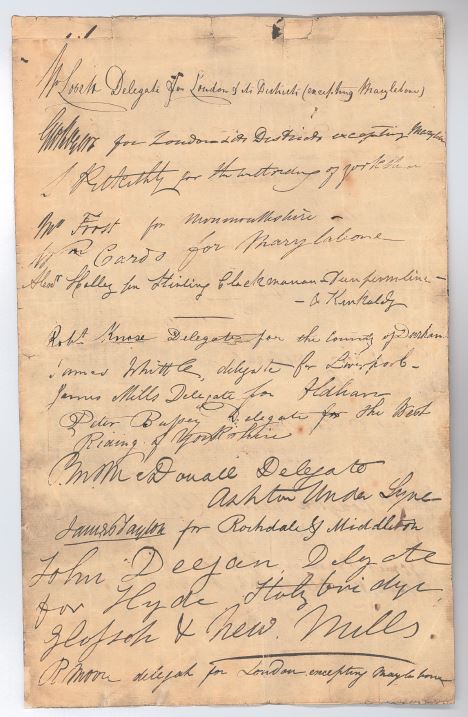
My collection of Chartist ephemera now includes this intriguing four-page document. Entirely without preamble or explanation, it lists 44 of the best known figures in Chartism, their names apparently written in their own hand.

My first thought when I got my hands on it was that this was the delegate list for a conference taking place on 19 November 1841 - a date which appears very clearly on the final page.

However, with further investigation, that appears not to be the case, and I have to say that it is not entirely obvious when the list was created or why. What I do know, and some thoughts about what it might represent, are set out here.

Download a PDF showing the document in full.

Saturday, 20 May 2017

George Julian Harney on "something of vital importance"

In the summer of 1839, George Julian Harney found himself under arrest in Warwick Gaol and facing trial for his use of “seditious language” to foment the “Grand National Holiday” or general strike called for by the Chartist Convention.

Thursday, 2 February 2017

A shared view of the Chartists: L'Illustration and the Illustrated London News

It is interesting to note that the great Chartist rally of 10 April 1848 made news across Europe at a time when many European radicals had other things on their mind. This was, after all, the Year of Revolutions, during which, it has rather unfairly been suggested, other countries overthrew their monarchs and proclaimed constitutions while in Britain we organised a petition.

Monday, 7 November 2016

Louis Blanc's Chartist connection: a letter to Holyoake

The French socialist Louis Blanc had been a significant figure in the provisional government of 1848. But despite having popular support for his plans to guarantee work for all, the left was a minority in government, and Blanc fled into exile after narrowly escaping arrest or worse.

Friday, 15 April 2016

Feargus O'Connor on land purchases and the Chartist land bank manager who thought better of it

Feargus O’Connor was a prolific writer. For many years he penned weekly addresses to the Chartist readers of the Northern Star each of which ran for thousands of words. In addition, he engaged in political polemic with opponents and rivals, and wrote copious advice on agricultural practices for those who shared his interest in small-scale farming.

Saturday, 11 July 2015

Feargus O'Connor's letter: deciphering a Chartist mystery

I recently came across and could not resist buying handwritten letter by the Chartist leader Feargus O’Connor dated 20 October 1838. The letter is badly water stained and carries a rusty mark from the paperclip which must have attached it to other papers for quite some time.